Looking for Something?

Showing posts with label public gardening. Show all posts

Wednesday, November 11, 2015

Victory veterans

I am keenly grateful for men and women who served in the military to protect my freedom. On this day of honoring U.S. veterans I also want to recognize the fascinating history of how civilian backyard farmers supported the troops: through Victory Gardens.

James Montgomery Flagg, 1918, National War Garden Commission. Source: modernfamer.com


Victory Gardens had their heyday during WWII, but actually began during WWI. Herbert Hoover was head of the U.S. Food Administration under President Woodrow Wilson and formed the program that encouraged people to consume less and produce more of their own food in their yards, playgrounds or city spaces. (Source: Virginia Historical Society.) The increase of personal vegetable and fruit production reduced the need for wartime rationing, and also freed up resources to support military efforts. Consider the effect on transportation, for instance. As more people raised their own food locally, the trucks and trains previously used to transport food were used to support the war.

At the end of World War I many people continued to garden of course, but it wasn't until 1942 that the U.S. government once again promoted Victory Gardens. At the same time the country started the Food Rationing Program.

I enjoyed reading this article about Victory Gardens: "World War II: Victory Gardens the Second Time Around."

The author stated:

Gardens began, once again, to change in the eyes of Americans, just as they had in the first world war.  They were no longer just for the poor, or for those who could not feed themselves, but for everyone.  Gardening became popular not only for food security, but for  it mental and physical health benefits and its benefits to the community.  Gardens gave a feel of productivity that citizens on the home-front needed.  A garden plot feels much more useful, productive, and important than a vacant lot or lawn.  With loved one off at war, it greatly improved morale to have an outlet for the patriotism, fear, and anxiety that many Americans felt about the war.  In 1942, about 5.5 million gardeners participated in the war garden effort, making seed package sales rise 300%.  The USDA estimated over 20 million garden plots were planted with an estimated 9-10 million pounds of fruit and vegetables grown a year, 44 percent of the fresh vegetables in the United States. (Bassett 1981)  

Work cited
Bassett, Thomas J.  “Reaping on the Margins: A Century of Community Gardening in 
America.”  Landscape, 1981 v25 n2. 1-8.
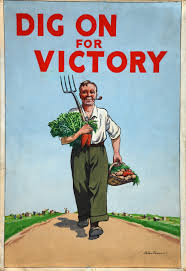

British poster by Peter Fraser. Source: Wikipedia

Victory Gardens flourished in other countries, too, as citizens of England, Canada, Australia strove to raise their own food. The good people of Germany also worked together to raise gardens and address starvation in their war-torn land.

Learning about Victory Gardens thrills me. Can you imagine if such gardens made a comeback? What if every person with a yard raised a garden with the intent to make the world better? What if every gardener preserved the harvest and shared knowledge and veggies with a neighbor? What if every person with a sunny windowsill planted some herbs? What if every person who raises a a garden for recreation used the savings on groceries to write a check to a charity that feeds the hungry?

I return to my appreciation for veterans who fought -- and keep fighting -- to make my life better. As it happens, my favorite veteran and my favorite gardener are one and the same: my dad.


The Veterans Memorial in his town overlooks the beautiful valley where he raises a vegetable garden and keeps a lush lawn for family baseball games. (Yes, that's him mowing DURING a game, because that's my dad!) This land is my land thanks to him and so many other brave souls.


Thank you, Veterans!

Monday, March 19, 2012

What is a Food Forest?

The Internet is abuzz lately over a Food Forest that is being proposed in Seattle. The Beacon Food Forest is a proposal that has been given to the city of Seattle as a potential community garden area on a 7 acre plot in Jefferson Park. It sounds a little different than a normal community garden or park. Here is a picture of the site schematic.

According to the Beacon Food Forest website a food forest is a "gardening technique or land management system that mimics a woodland ecosystem but substitutes in edible trees, shrubs, perennials and annuals.  Fruit and nut trees are the upper level, while below are berry shrubs, edible perennials and annuals.  Companions or beneficial plants are included to attract insects for natural pest management while some plants are soil amenders providing nitrogen and mulch.  Together they create relationships to form a forest garden ecosystem able to produce high yields of food with less maintenance."

This sounds like community gardening on steroids as it goes beyond the garden to creating and entirely edible ecosystem. This is not an edible ecosystem the likes of Willy Wonka either. It's not candy, but instead, food that is good or healthy for you. Eat your heart out Willy.


While it seems like a great idea, I couldn't find a lot of information on how this will be funded and since money makes the world go round, a big part of their success will be determinant on whether they can raise funds and make it economically feasible.

I am a big fan of any idea that gives people that might not otherwise have the chance to garden, the opportunity to grow their own fresh food. I hope this works and I look forward to following the progress of the Beacon Food Forest.

Write a comment below if you have participated in something similar to the Food Forest. I would love to feature other successful community gardens or food forests on our blog.

~Michael~

Friday, January 27, 2012

Strange Things are Afoot at Chicago's O'Hare Airport

What is the first thing you think of when you hear the word airport? Metal detectors, full body x-rays, vacation, and delays are some of the first things that I think of. I probably would have never thought of the words vertical gardening or aeroponics gardening. The Chicago O'Hare airport hired  the company Future Growing LLC to create an aeroponic food farm withing the airport. The garden is harvested by restaurants within the airport to use for their meals. Check out some of the pictures below taken from the futuregrowing.com website. These beautiful displays are inside an airport!


I love the idea of having gardens growing in public areas. Let's use every inch that we can to grow fresh local food. If an airport can do it, then we should be able to find a place or a way to grow food. 

On of our reader's Michael A sent me a link about this. Thanks Michael for the idea.

~Michael~