Looking for Something?

Showing posts with label kids. Show all posts

Friday, September 30, 2016

A different game of squash


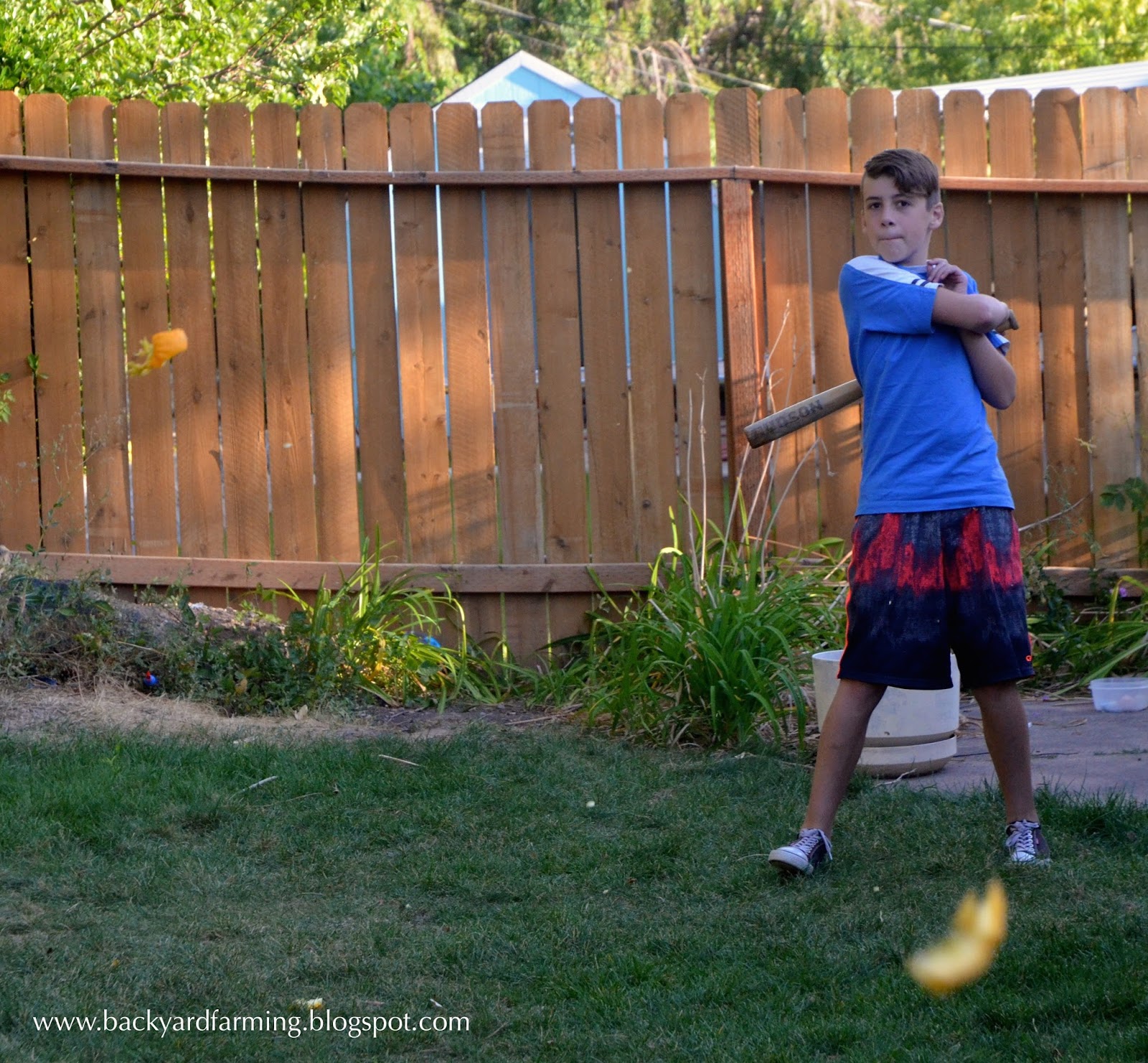
Q: What do you do when summer squash morphs from tenderly edible and cute to a rock-hard, warty weapon? (Oftentimes before you or your *harvest crew ever spy it in the garden!)

A: You unleash your own weapons of mass destruction (aka: your boys) to break the squash into compost-able smithereens.

"Really, Mom, you WANT us to hit the squash? This is awesome!"

Tell the boys they need to rake the spoils so you can measure who has the biggest pile. 

Mom for the victory!

*(Wait, that's fewer squash for the boys harvest crew to eat. Ooh, they're sneaky.)


Wednesday, May 11, 2016

Another bouquet of seed reads

One of my favorite things to do is read books with the children in my life. Here is another round-up of gardening-themed books to inspire you and your listeners. Click here or here to read two other posts on this blog about more garden book favorites.


Zora's Zucchini 
By Katherine Pryor, illustrated by Anna Raff

Elementary ages. Three days into summer vacation Zora is bored, well, out of her gourd. While riding her bike she spots free zucchini starts at the hardware store. (Adults will be amused by the original sale sign crossed out to plead FREE!) Zora comes home with 12 zucchini starts and plants them all. This oversupply sets up the rest of the plot as Zora must figure out how to not let the food go to waste. The book's end notes posit that "about one-third of the world's food is wasted, which means that all the water, work and time it took to grow that food is also wasted." The story is a great springboard for discussion on what to do with extra food.


The Tiny Seed
By Eric Carle

Preschool and up. Carle's signature collages depict a journey through seasons as an autumn wind propels seeds across oceans, mountain tops and deserts. Children will enjoy identifying the tiny seed on each page. Naturally, the tiny seed outshines its travel companions and grows into something amazing.


The Watermelon Seed
By Greg Pizzoli

Preschool and up. This light-hearted story isn't really about gardening but invites a discussion about what a seed needs to sprout. Children who know that seeds need soil and sunlight will laugh at Crocodile's plight when he fears a swallowed watermelon seed will grow inside of him. (His dread of becoming a fruit salad is delightfully illustrated.) Use this tale to reassure children just learning about seeds that no, they won't become human seed pots.


My Garden
By Kevin Henkes

Preschool and up. A girl thinks her mother's garden is nice but too much work. If she had her way flowers would always bloom and change colors and patterns to her liking. She wouldn't have to shoo bunnies from the lettuce because the bunnies would be chocolate and she would eat them. This book is a great launching pad for a creative writing or art project of what listeners would want to grow in their own gardens.


If You Plant a Seed
By Kadir Nelson

Preschool and up. Beautiful illustrations, with few words on each vast spread, relate the story of a rabbit and mouse who balk at sharing the fruits of their labors. The book covers gardening basics with the parallel to planting seeds of selfishness vs. seeds of kindness. Get this one just for the actual-size, intense stare-down of visiting birds.


A Gardener's Alphabet
By Mary Azarian

Preschool and up. Bold wood cut illustrations and sparse one-word or phrase entries take the viewer from A to Z. The meat, for grown-ups, is in the artist's introduction. She considers gardening the most difficult of the arts, with its demands of design and color skills, knowledge of plants and climate; and all at the mercy of fickle weather. Sometimes it's better to give up and go on a trip! Yet, "The garden provides such an intriguing challenge and is such a source of wonder and joy that to not garden is unthinkable."


The Curious Garden
By Peter Brown

and

Tokyo Digs a Garden
By Jon-Erik Lappano, illustrated by Kellen Hatanaka
Elementary ages. These two books follow the same theme of living in industrial scenes practically devoid of nature. In both a boy is an agent of change but with different reactions in their towns. Read together, these books frame a thoughtful comparison how our attitudes toward nature ultimately influence its survival. We may get what we deserve.

In The Curious Garden, a boy explores abandoned elevated train tracks and is surprised to see a few lonely, bedraggled flowers -- the only plants in the area. They need a gardener. The boy makes mistakes at first, but he nurses the patch to health. The restless garden yearns to explore and spreads through the city. The townspeople likewise come to life with renewed interest and appreciation for cultivating nature.

Second, Tokyo lives with his grandpa in a small house surrounded by tall buildings. Grandpa tells stories of how things used to be: deer in meadows, salmon leaping from streams. It's all gone. The city had to eat something after all, the grandfather shrugs. Tokyo receives three seeds from a strange woman; she promises him they will grow into whatever he wishes. It takes some searching to find a piece of ground, but sure enough -- when Tokyo plants them the seeds sprout and change the landscape overnight. The return of wildlife inconveniences people so much that they question, What are we going to do? Says Tokyo, "I think that we will just have to get used to it."

What are some of your favorite books?

Wednesday, April 13, 2016

Off-site gardening: Factors to consider before starting roots away from home


Joining a community garden or using extra space in a friend's yard is a great way to grow crops when you don't have room at your own home. You may also know a business or school willing to loan you an area for the summer. Another option is to do as reader Dave Bentz did and purchase vacant lots in his city to convert to gardens. 

I have done three different gardens away from home: a community garden plot offered to university students; part of my husband's grandma's yard, which we shared with his brother; and, most recently, a section next to our friend's cow pasture in our town. My kids called this the "cow garden". We lived in an apartment for the first two gardens, but raised a home garden at the same time we had space near the cow pasture. 

No matter what kind of off-site garden you pursue, maximize the experience by considering these factors:

1. Time. 

This is the single most important factor. Be realistic with how much time you can devote. Include travel time. We dedicated Mondays to take our children to the cow garden and work together. Without a scheduled commitment it is far too easy to say, "Eh, we'll just get to the garden later." Such was the case with our first off-site garden, the university one. Although I was super excited for the plot, the garden fell by the wayside behind our busy jobs and school, fatigue from my first pregnancy and the fact we had only one car. The garden was too far for me to walk when my husband used the vehicle on his job. Excuses, excuses. 

2. Location. 


Go close! If that's not feasible, find a spot that you pass during your regular commutes and routines so you can keep an eye on the garden beyond your scheduled days to work there. Use the same criteria as you would siting a home garden: Does it get adequate light? Fences, trees or other structures that cast shade should be north of a garden area. Afternoon sun (from the west) is harsher than morning light.

3. Space.

There is a space/time relationship just like there is a location/time connection. The bigger the space, the more time it will require to set up and maintain. If you are using a space larger than your home garden you may need to expand your thinking, too. For example, our first summer at the cow garden we planted veggies as close together as we do at home in their grow boxes. If we had known how ferocious the weeds would become, we would have allowed space between plants for a rototiller. 

4. Water

Does the plot have access to water? This is a must in dry climates. Will you pay for water? Is it a sprinkler system, hoses or both? If it is sprinklers, do you have a contact person readily available if something goes wrong with the pipes? (Another reason to check your garden regularly.) One of the biggest contrasts between my home garden and the off-site cow garden (raised simultaneously) was in the watering method. At home I use soaker hoses, drip lines or water plants by hand with a watering can. I seldom get weeds because the ground between plants is not watered. The cow garden's shooting sprinklers, however, watered EVERYTHING. The weeds went wild. The cow garden automatic sprinklers were high on stakes. This overhead water delivery, and the frequency of it, caused more powdery mildew and fungus problems in foliage than I ever had at home. Squash and tomato plants did not fare well, and the tomato skins frequently split.

5. Soil. 

Will it need extensive improvements? If the area has not been used for recent plantings, find out what was there in the past -- old leaky cars could suggest chemical leaching.  It may be worth your while to do a soil test first. At the cow garden, in spring our friend cleaned his barn and spread the manure into the plots. Since the cows had been feasting on weeds, those seeds simply got relocated. The weeds were bionic. 

6. Sharing.  

If you share the space with someone else discuss the division of duties at the beginning of the season. Maybe you work together to till the soil in the whole area and join forces again in fall to clean up. How will you set up traffic areas so that no one's plantings are trampled? Be courteous when planting your crops, remembering that tall ones, like corn, can cast shade or block sprinklers. Pumpkins, squashes and other vine crops will amble well past their boundaries. (There's a reason my kids called it the cow garden!)


Yum, banana squash. Moo.


7. Equipment.

Are tools, hoses and other implements on the property or will you need to bring your own each time you come to your garden? Consider keeping gloves, a spade and a harvest bucket in your trunk so you are ready for impromptu visits.

8. Commitment for the season.

Are you relatively certain the property where you garden won't change hands before the growing season ends? I appreciate that our cow garden friends didn't open up their property for gardening last spring, on the off chance they would need to sell. They didn't want someone to go to all that work without the harvest.


So there you have it. Off-site gardens can supplement your own backyard farm or give opportunities to people who have no space otherwise. I fear my disdain for the cow garden weeds and watering issues came through loud and clear in this post! Still, I am grateful for these new gardening lessons, and to have extra space to produce a harvest like the one above, all picked on a beautiful September morning.


Check out this site for a weekly roundup of ideas from fellow homesteaders.


Monday, February 8, 2016

Seed packet Valentines


Plant seeds of joy for your garden-minded friends and family with Valentine cards made from seed packets. It's a playful, practical gift that will keep you on the recipient's mind throughout the growing season. The ones I made today are from easy-to-find seed varieties, which I plucked up 10 for a buck at the dollar store. Sure these valentines are corny, but isn't that what smiles are all about?


LETTUCE BE VALENTINES

Let's be SWEET HEARTS (plant: sweet basil)

You are the best thing in my COSMOS

We are MINT to be! (plant: spearmint)


I CARROT A LOT about you!


You can't be BEET


This next batch is a little more obscure, drawing more from words on the packet than the plant itself:


You are my ANNUAL CHOICE, Valentine! (plant: phlox)


I find you CHARMING, Guaranteed! (plant: viola)


Valentine, you are Hot & Spicy! (plant: jalapeño pepper)


As I've pored over seed catalogs I've noticed many plants that convey sentiment in their very names:

(quotations indicate cultivar names)
“Angel face” floribunda rose
Bleeding heart
“Daydream” tulip
“Everlasting” sweet pea
Forget-me-not
Honesty plant
Love-lies-bleeding
Love-in-a-mist
Kiss-me-over-the-garden-gate
Obedient plant (eh, maybe not!)
“Romance” narcissus
“Valentine” sunflower

Here are other seeds that could be great for Valentine cards:
“Black Valentine” beans
“Hearts of Gold” cantaloupe
“Hungarian Heart” tomato
"Marvel" lettuce
"Tendersweet" carrot
Instead of traditional trinkets, you could give a growing, botanical version:
Candytuft
“Diamond” eggplant
“Golden treasure” pepper
“Chocolate beauty” pepper
“Teddy bear” sunflower
“Lady Godiva” squash, anyone? (Nah, Godiva chocolates are probably better.)
Show that you appreciate your Valentine’s special qualities by pointing out:
“Good Mother (Stallard)” beans
“Provider” beans
“Country Gentleman” corn
Use your imagination, and let plants do the talking this Valentine’s Day. Take it from me, though. These may be incredible plants, but for the holiday’s sake steer clear of sending a message with "Envy" zinnia, “Lazy Housewife” beans or “Seneca Red Stalker” corn.

Friday, December 4, 2015

Decorate gingerbread house as a bird feeder


Here's a favorite seasonal project from the Backyard Farming archives: ditching the candy of a traditional gingerbread house and decorating with treats for the birds instead. (Read here to see how my candy frustration fueled this idea!)

Use popcorn, crackers, sunflower seeds, shelled peanuts, pretzels and -- what else? -- birdseed to adorn a gingerbread house. The house shown here is a grandpa special, made out of wood and designed for perennial use. You may use regular gingerbread, graham crackers or even simple cardboard boxes as the base. Of course you'll want to put a bird feeder house outdoors, but make sure it is in a sheltered area where it won't get damaged from rain or snow, such as on a covered porch. Put it somewhere you can watch from a window.

Instead of icing, I used a mixture of peanut butter and cornmeal to attach the bird treats. The cornmeal makes the peanut butter easier to spread, and is also easier for the birds to eat. Another option is shortening in place of peanut butter (still mixed with cornmeal).


Not only is this a fun project to make, you get the added benefit of watching birds join in the winter celebration.

Friday, October 23, 2015

Halloween story idea


Here at Backyard Farming one of my goals is to find joy in the seasons and share it with others. Join me in taking a break from gardening chores to create this Halloween story. It is fun to do one-on-one with a child or with a group of children, such as for a Halloween party.

I first heard it years ago from a library storyteller, and so charmed was I, I went through stacks of paper sharing it with all the littles in my life. (And bigs, too, who are young at heart.)

Tell the story as you do the cutting, and be prepared for all your listeners to want to recreate the tale themselves.


Here is my own version of The Witch's House:

A little witch was traveling home after visiting her friend. It suddenly became so windy that she couldn't continue flying on her broom. She decided to make herself and her cat a house for the night.

The first thing she found when she landed was a piece of paper. Now, to you and me that might not seem special. But witches are magic!

1. She folded the paper in half so she could go inside. (Fold widthwise.)


 2. She cut off the top corners to make a roof (non-folded edge).


3. Got to have a door! The witch started to make one. When she got to the top she decided the door should be pointy so her pointy hat would fit.


4. "Meow," said the cat. He wanted his own door, the silly thing! The witch cut a very small door next to hers, just the cat's size.


They both went inside. The house was warm, but oh, so dark!


5. The little witch went back outside and cut out a window in the shape of a half moon -- just right for letting the moonlight shine in. (Fold paper between witch's door and left edge up about halfway. Cut window farther left than cat's door -- near where thumb is in photo.)


The witch loved her new house. Can you see why?


Seeing your audience wide-eyed in wonder will make your day. I promise.

Thursday, October 15, 2015

Lord of What Flies


Said 8-year-old Samuel: "I like the way grasshoppers jump out of my way and clear a path for me. It makes me feel like a king!"

Ah, to have the joyful perspective of a child.

Tuesday, June 21, 2011

A Weed is but an Unloved Flower

A weed is but an unloved flower.  ~Ella Wheeler Wilcox

I'm loving my weeds right now. My daughter Maya is turning 8 soon, and I had birthday pictures on my mind. The morning was cool, the sky was blue, the grass (weeds) were vibrant green. I had Maya throw on a simple white dress and I straightened out her bed head. Sometimes impromptu unscheduled pictures work out the best. I am so pleased with these pictures of my beautiful daughter and my beautiful weeds. 

(Notice my cute little red chicken coop below)

Maya will play "model" for about a half hour, then she morphs back into the spunky, silly, funny girl that I adore.

How is your weed situation?

~marisa