Looking for Something?

Showing posts with label food storage. Show all posts

Monday, November 9, 2015

Tips for storing end-of-season tomatoes


Last week I rushed to the garden to pick as many tomatoes as I could in anticipation of frost. The weather forecast frost forced my hand and I had to harvest RIGHT THEN, but once picked the still unripe tomatoes are rather undemanding about when I need to do anything with them. Today I separated the tomatoes by color or, in other words, by the degree of ripeness. I put a sheet of newspaper in nursery flats and use those as trays for sorting and storing the tomatoes spread out from each other. This is important -- tomatoes that touch each other are more likely to rot.


I will place these flats in a cool, dark area in my home. The color/ripeness classification makes it easy to identify which tomatoes need to be used first. (Pasta sauce, coming right up!) The sorting practice further makes me examine each tomato; those that have any cracks or soft spots aren't worth storing until they ripen. They'll spoil first.

You can either wait for tomatoes to slowly, slowly ripen in the cooler storage area, or you can bring a them into the warmth of your kitchen a few days before you expect to use them to hasten the ripening. The tomatoes probably won't reach the same brilliant red of summer, but they will pack a tasty punch.

Another tactic for long-term storage is to wrap green tomatoes singly in paper. A standard sheet, 8.5 by 11 inches, is the ideal size for one tomato. I had a wonderful next-door neighbor who swore by this method, and it was my privilege to help her with this and other gardening tasks when she was in her 90s. (I miss her!)  I can vouch she had tomatoes into January. When doing this check a few tomatoes every week to assess level of ripeness.

This year I'm putting that method to the test, by wrapping half of my green tomatoes in paper, and leaving the others spread out on the tray. I will store them in the same place and see what happens. I'll share the results. I'm not sure what benefit the paper offers. Anyone know? I had a theory that the paper makes a barrier from ethylene gas from nearby ripening fruit. I looked for substantiation online and found conflicting info in two articles on the same site. One said that putting a tomato in a paper bag will concentrate the ethylene gas and make the tomato ripen faster. The other, (mind you, at the same site), said wrapping tomatoes in paper reduces the build-up of ethylene and slows ripening. Okey-dokey. (An aside: My 11-year-old has a science fair project due this week -- don't know what it will be yet -- which perhaps fuels my scientific yearnings!) Stay tuned!

I mentioned that I first put a piece of newspaper in the flats, which is because the plastic bottom is a wide grid instead of a solid piece, and I don't want tomatoes to fall out. The coincidence of this ad made me smile and reminded me why I bother saving the tomatoes in the first place:
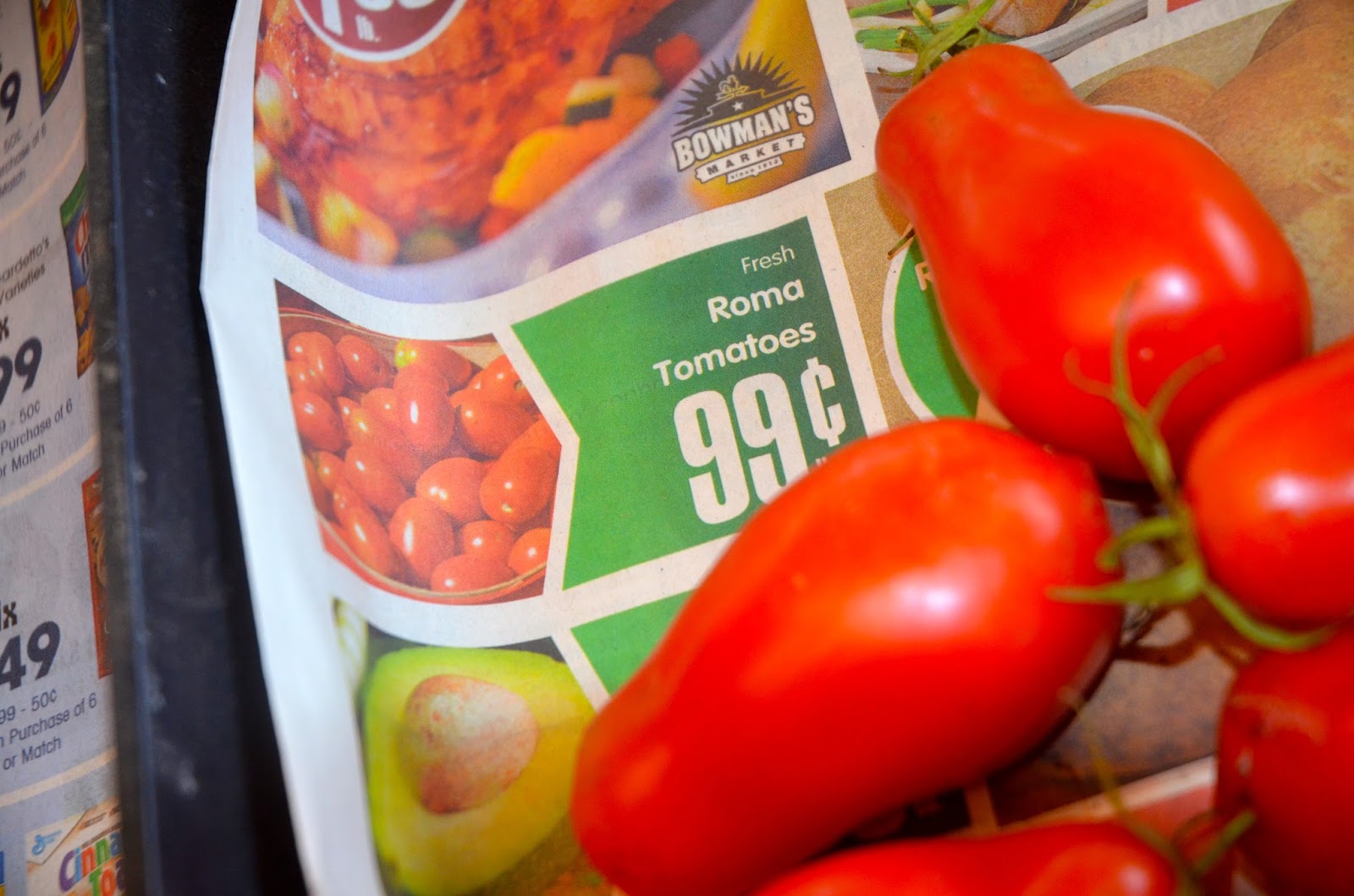


They'll be much more expensive in winter! How long have you successfully stored fresh tomatoes?


Tuesday, August 25, 2015

A tip for space-saving flash-freezing


First of all, what is flash-freezing?


It is the process of freezing select food items in a single layer, such as on a cookie sheet. Once frozen, the items are transferred to a sealable plastic bag or other airtight container. The main benefit of flash freezing is that items can be stored close together in the bag, but can be removed in desired portions without the entire clump sticking together. 

Whole berries, sliced fruit, peeled bananas, peppers and tomatoes are easy to freeze. (Bananas work best with wax paper spread on the sheet first.) Other vegetables, like green beans, need to be blanched first. Blanching halts enzyme action, and is done by briefly boiling vegetables (beans, for instance, for three minutes), and then immediately plunging into ice water for double that time. The blanching step freezes vegetables at their most colorful peak.

But back to my tip. The only disadvantage of flash freezing is you need a lot of flat area in your freezer. I like to stack cookie sheets to consolidate space.


Find two objects of identical height and put them toward the edges so the tray above it will be balanced. You want something taller than the items on the sheet to ensure air circulation and obviously, so they are not crushed. Here I have used two yellow cups. Then stack your other sheet on top, for a double-decker space-saving flash-freezing option. Whew, that's a lot of hyphens!


After a few hours in the freezer, or overnight, transfer the items to your container. Another tip is to use a straw to suck out all the air from a zipper-style bag (oh no, not again) as you seal it closed. Easy-peasy. (sigh)

What do you freeze best?


Wednesday, January 16, 2013

Food Storage Seeds

Many of you know that we are big fans of heirloom seeds here at Backyard Farming. We were at the store the other day and we saw a can of heirloom seeds that you can put in your food storage. We have seeds that we bought a few years ago in our freezer, but I like the idea of buying them canned. The seeds we saw said tehys are good for 4 years. The nice thing about heirloom seeds is that you can harvest the seeds from your fruits and vegetables and then plant them the next year which gives you a perpetual garden. This is not something you can do with most hybrid varieties. I decided to see what I could find online in regards to similar products and here are a few I found. Backyard Farming not affiliated with any of these sites. Our intention is not to endorse any particular site but instead to give some ideas for what is out there.


  • 20 varieties of hardy heirloom survival seeds passed down from our forefathers.
  • Survival seeds rated for 5+ years of storage at 75F, longer at lower temperatures.
  • No hybrids, GMOs, or outdated survival seeds. All harvested seeds are reusable.


  • They allow you to harvest your own seeds, giving you the ability to plant a garden from year to year.
  • Seeds have been specially dried to just the right level for long term storage.
  • At 65-70°, they will store for up to 4 years.
  • Hermetically sealed in E-Z Lock Reusable Triple-Layered Foil Bags.


  •   16 large seed packets sealed in a #10 can.
  •   Plants nearly 3/4 acre of Garden.
  •   Will keep up to 4 years if stored at 66 to 70 degrees and much longer if kept colder
  •   All Non-hybrid, open pollinated varieties
Would you consider adding something like this to your food storage? Have any of you bought something like this in the past and then used the seeds? I would be curious to know how they worked for you.

~Michael~