Looking for Something?

Thursday, September 24, 2015

Garden fatigue

It's confession time, folks. I'm tired of my garden this year! I came across this picture of my garden from years ago and laughed.

There's a lush grouping of pole beans on the back left, stout silver-green broccoli plants in front of that, tall tomatoes on the right, and zinnias in a colorful pompon border between the wooden garden box and the row of large rocks.

Here's that zinnia border:


And a look inside the box, with kids to show the scale of the plants (perhaps that's why she's holding a stick?):


A drip line? Holy cow! I'd forgotten my garden ever had that.


Look at my garden today:


Granted, this shot is September and the others are July, but come on! My garden path has turned to garden apathy. The pole bean frame is bare because so few seeds below it sprouted this summer that I didn't bother attaching strings for them to climb. Overgrown, woody sage plants have all but obscured the large rock border, which once was distinct from the lawn it abuts (if we can call it a lawn anymore!). The light green hose -- the only source of water here --  is never put away. Weeds are everywhere. Even the fence looks defeated.

The first picture is from 2006, the first year we had a garden at this home. We cleared the area and made the boxes that spring. Clearly, I tended the garden better then! I think I laugh at the comparison because really, I am confused. I don't get it. I was in the throes of raising little kids then. They are older and more self-sufficient now, which should leave me with MORE time for gardening, not less. Right? I don't get it.

There's a season for everything, they say. If memory serves, the mom/gardener of 2006 felt a bit frazzled, too, but I laugh with new assurance that I don't need to knock myself out on the gardening front. Bedraggled September gardens still yield rewards.


But not too much, because that would be crazy.

Wednesday, September 16, 2015

Gardening up close -- do you have photos to share?

One of the things I love best about gardening is the time spent rubbing shoulders with plants helps me see amazing details I may otherwise overlook. Here are a few of my discoveries this summer.


The majesty of light and water in trapped rainfall on a pea leaf.


Two sleeping bees in a pod: (OK, gaillardia flower)


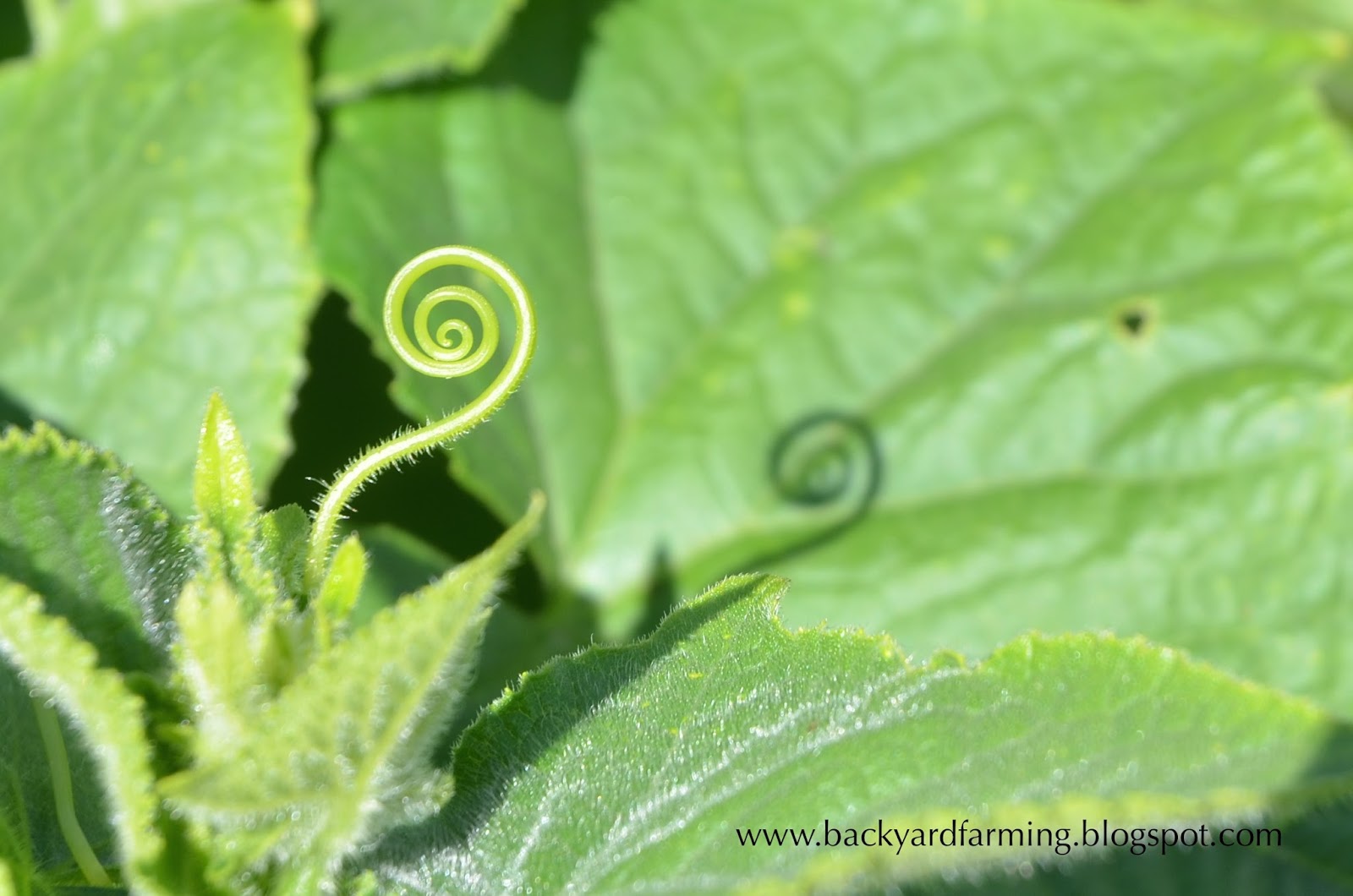
The energy of a cucumber vine ready to unfurl:


Do you have favorite garden shots you'd love to share? Email them to me at jkhgardener@gmail.com. If you don't already have a word mark on your photo, tell me what you'd like me to add before I post -- so you get all the credit. (Please, your work only.) If you have a website include that information for me to share. Email me by Sept. 30.

Let's inspire each other with the beauty we see!

Monday, September 14, 2015

Planting convictions


Like many people, I spent the weekend reflecting on 9/11. I measure it most in the pregnancy of my third child. What kind of world, I wondered that day with horror, am I bringing this baby into?

I feel for all those who lost loved ones. I myself was very removed from the tragedy; my closest tie was an in-law's brother working in New York, but whom we established early on was OK. Still, I felt a personal pang deep inside and couldn't shake my fear. What kind of world was I bringing this baby into?

My friend, who was also pregnant on 9/11, recently visited the memorial and took this photo.

Later in the week on the way to my job at a wedding reception center, I passed a row of flags staked for blocks along the curb. Dozens of flags, dancing in the breeze of the late summer day. I wept.  I didn't see the people who lived in those homes, but I imagined them standing next to those flags in a show of solidarity. Politics didn't matter. We can go forward. Together. It will be OK.

My daughter arrived, past her due date, on Election Day. (I didn't make it to the polls that year.) 

In the 14 years since 9/11 my circumstances haven't changed too much. My daughter is older, sure, and I am ever grateful that we have a home, a piece of land, education, and doctors to help us when we are broken. I am mindful that people all over the world lack these. I tremble at the horrors others must face. What kind of world do we live in? Sometimes I get discouraged that I can't do more to ease their suffering, that my sphere of influence is so tiny. 

As I sat to write this my phone rang with automated messages from our school district about a police lock-out order issued and lifted earlier today following an area armed robbery.  What in the world?

Yet, I want to see the good. This afternoon when my daughter comes home I will hug her and be excited about her ballet audition.  I'll watch her go to the garden and pick yellow pear tomatoes, her favorite snack. 

I want her to know that every time I plant a tomato seed, it is because I have faith it will sprout. I want her to know that every baby and every wedding represent hope of a bright future. I want her to look forward to making her own big choices  -- and trust that she lives in a world where planted trees and planted flags speak of promises worth championing. 

Thursday, September 10, 2015

Effective use of parking strip space: raised beds for strawberries

Many communities have an area known as a parking strip, which is a narrow piece of ground between street and sidewalk on private residential and business lots. This is also called a parkway. Sandwiched between two pieces of city property, the parking strip isn't exactly a prized canvas for landscape design. Most parking strips I've ever seen are either filled with rocks or lawn. In the case of lawn in the strip, this can be a terrible water-waster when sprinklers irrigate more of the sidewalk than grass.

This yard, in contrast, shows a great use of the narrow parking strip space with raised beds for strawberries.


The homeowner attached reflective panels to the beds on the street side for greater visibility when people park their cars. The beds are built around the water meter.


Note: some city may have restrictions on whether structures can be added to a parking strip; check with your town first if you're thinking of making garden boxes there. (How I feel about such nitty-gritty oversight is a post for another day!)

I'm always on the prowl for productive uses of the parking strip, and would love to learn what ideas you've seen or implemented. Strawberries taste better than grass, don't you agree?

Friday, September 4, 2015

Do gardeners make good neighbors?

These kinds do!


I saw this handmade box coming home from errands on a new route. Isn't this the most charming thing ever? It gives me hope in humanity, and in cukes and zukes, too.

I drove by another day to see the box brimming with pears. This time I was bold enough to knock on the front door to introduce myself and chat with the homeowner, Becky. She told me her family decided to do this after seeing a picture of a similar box. Neighbors help each other in a give-and-take all summer. "We always have enough to share," she said.

And that, my friends, is one secret of raising a good garden: when you desire to share you will have abundance.


Check out Maple Hill's seed to table series today about avocados.

Friday, August 28, 2015

Easy microwave summer squash recipe


This is one of my favorite ways to cook yellow summer squash. It takes longer to walk to the garden and harvest than it does to prepare.

In a 1-quart glass casserole or other microwave-safe dish mix:

1 squash, cut into 1/4-inch slices
About 3 Tablespoons chopped green pepper

Season with salt, pepper and paprika to taste.
Add pat of butter. (This is optional, but come on! It's butter, yum.)

No water is necessary. Cover with glass lid or plastic wrap. Microwave at high power, checking after 3 minutes. This is the amount of time to cook this in my 1100-watt appliance; adjust times accordingly for your microwave.


Be sure to check out Maple Hill's seed-to-table series today. This week's entry: Parsley.

Wednesday, August 26, 2015

Home orchards


Fruit trees can be an attractive part of a home landscape, as this carefully planned orchard shows.


The orchard space is about 16x16 feet on the west side yard of a historic home in my city's downtown. In the center is a pear tree flanked by two apple trees and two peach trees. The five trees are laid out in a circular cross design with islands of light brown bark mulch separated by black edging and light colored gravel paths. This ground design is striking all year long, perhaps even more so in winter when the trees are bare. The mulch serves an extra purpose: it covers the drip-line irrigation system. All the trees are dwarf varieties.


A bed of strawberry plants borders one side of the grid, which fits right in with the owner's orchard motivation: "Because we love fruit."


Here, the trees create a privacy screen between the street and the house.


This is the front of the beautiful home, with the orchard shown on the left. The home sits on a large lot, but its compact orchard offers inspiration for using fruit trees in residential landscapes of all sizes. These strategies are worth noting:

• Choose dwarf varieties for small spaces.
• Separate fruit trees from lawn if you can. First, their water needs are different. Second, grass will not grow well under a fruit tree's canopy. 
• Think of a tree's pollination needs. Most apple varieties require another apple tree nearby to produce fruit.
• Use landscape cloth and mulch to cut down weeds. Consider adding a design element with your choice of mulches.