Looking for Something?

Showing posts with label Compost. Show all posts

Friday, September 30, 2016

A different game of squash


Q: What do you do when summer squash morphs from tenderly edible and cute to a rock-hard, warty weapon? (Oftentimes before you or your *harvest crew ever spy it in the garden!)

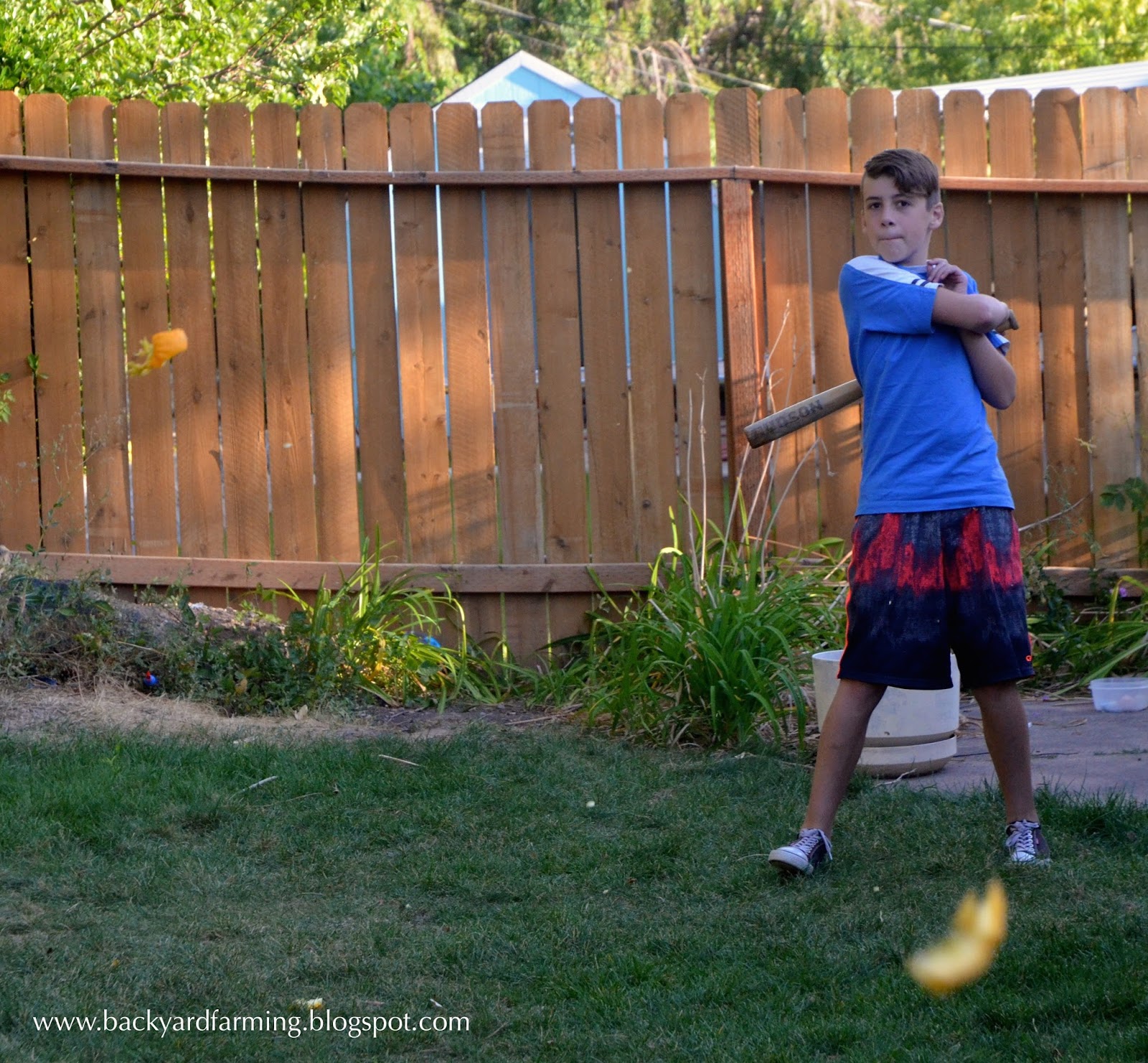
A: You unleash your own weapons of mass destruction (aka: your boys) to break the squash into compost-able smithereens.

"Really, Mom, you WANT us to hit the squash? This is awesome!"

Tell the boys they need to rake the spoils so you can measure who has the biggest pile. 

Mom for the victory!

*(Wait, that's fewer squash for the boys harvest crew to eat. Ooh, they're sneaky.)


Thursday, May 5, 2016

Rhubarb leaves as weed barrier and mulch

The large size of rhubarb leaves makes them easy to place between garden rows or around the base of plants as a weed barrier and mulch.

That's what I discovered when I looked at rhubarb with new eyes after a destructive storm forced my harvest of more stalks than I would typically use at once. What to do with it all? And could the leaves be useful somewhere, other than just in the compost bin? We had a fierce windstorm in my neighborhood this week that brought trees crashing down through roofs and sent debris all over tarnation. My home was spared (this time!) but the wind shredded many plants and outright obliterated the wood chips around our garden boxes. That layer of mulch is gone!

I always love when one garden issue -- in this case, the oversupply of rhubarb -- becomes the solution to other garden problems: replacing mulch and blocking weeds. I overlapped the leaves on the ground between garden boxes. I also put them around the base of strawberry and raspberry plants. The quails are back in my yard with their telltale pits in the soil. Rhubarb leaves are now the rugs those birds can't dig under. 

Increase the effectiveness as a weed barrier by layering the rhubarb leaves and adding new ones as you harvest more stalks. The leaves break down quickly. On the left is a a freshly cut leaf. The one on the right was cut two days before.


When I harvest a rhubarb stalk I hold it in one hand and swing a knife at the leaf base with the other hand like I'm wielding a sword. (Can't imagine where I got that idea!) Easier and way more fun than using a cutting board. 


Tuesday, February 12, 2013

Decisions on Cleaning green Waste


By Jennifer


I am hosting an inner debate. My city recently announced a voluntary curbside green waste recycling program. I am excited the city is going this direction, in a move that will surely reduce the amount of waste
in the landfill. 

The problem? I'm not sure I want to join.

See, at the same time I want to support environmental measures, I also want to do what's best for my household. That means a different kind of green speaks loudest: money.

The city program will cost $6.50 a month for a 90-gallon green waste container that is collected once a week. Accepted green waste is lawn cuttings, clippings from bushes and shrubs, leaves and produce.
Collected materials will be made into compost. (I've yet to learn if that compost will be made available to residents.)

In my city your first trash container (black 90-gallon bucket) costs $11.50 per month, with any additional containers costing $8 a month.The city is pitching the green waste program as a cost-saving measure for those who replace a second black can with a green waste can. Current cost for two trash containers: $19.50. Cost for one trash container and a green waste container: $18.

Most households on my street have two black cans. Our home does not --even though our family of seven could easily fill two cans if I tookthat route (or cleaned under my teenager's bed)! Instead we've made
efforts to minimize our trash by recycling paper, cardboard andplastic; and by donating our outgrown clothing and other household items we no longer use.

With green waste in particular, we have traded lawn space for other plantings, and mulch the grass clippings right back onto the lawn instead of throwing them away. We make compost. We have lots of trees
whose leaves, come fall, go into our garden plot; we don't bag the leaves for garbage collection.

At the end of summer we do have a lot of green waste in profusion when we cut back perennial flowers and remove large vegetable plants. These items exceed our compost space, so we opt to take them to the green
waste collection point at the landfill. Cost is $5 a truckload. We generally make two or three trips.

All told, the green waste program would cost me $96 a year. Did I mention that green waste isn't collected Dec. 1 through March 31, but that the green waste container may be used for a regular trash can
then (which I don't need)? So make that $96 for eight months of green cleaning.

I'm torn. I applaud the city for starting this program and I want it to succeed, even if it doesn't make sense financially for me. Should I consider the cost to me an investment in the greater good of the
community? If I opt out will I forever feel guilty for every seedy dandelion (my compost no-no!) that I throw in the black bin? How badly do I want that 90-gallon green badge of honor on my driveway?

I'd love to hear your thoughts as well as learn about the green waste programs in your communities.

~Jennifer~

Tuesday, May 3, 2011

Excellent Adventures in Backyard Farming

Have you seen the famous B movie Bill and Ted's Excellent Adventure. It is the true story (maybe not true) about 2 high school metalheads that are the epitome of pathetic. They get a visit from Rufus, a man from the future, that tells them that if they don't pass their history class, they will not go on to form the music that is the basis for a future Utopian society and the earth will be doomed. They then travel through time to prepare for the best history presentation ever. Don't worry if you haven't seen the movie, the point is Bill and Ted are slackers that go on to do great things. Much like Bill and Ted we found out recently that our soil is pretty pathetic as well.

You might ask how how we know that we have sub par soil? We took our soil into our local extension recently and we found out what we already expected. Our soil is pathetic, lazy and vile. It is very alkaline, and there are extremely low levels of Nitrogen and phosphorous.  For more information on soil testing got to this link and read the PDF articles entitled Why should I test my soil and Soil testing guide for home gardeners.


It was not a huge surprise that our soil is the equivalent to a high school version of Bill and Ted. We have talked to other gardeners in our area and they have warned us that it will take some work to get the soil up to par. The long term remedy to all of our problems is compost, compost, compost. Many of the gardeners around here use mink manure compost for their gardens.

As I researched using mink manure, I found that it is high in phosphorus and nitrogen, both of which our soil is in need of. We paid someone to bring us 7 square yards of manure that had been composted for more than 3 years with pine shavings. They dumped it in a pile on our property (see picture on left). Not only does the manure add the needed nutrients, the composted pine is supposed to reduce our soil alkalinity as well. Who knows, maybe one day our slacker, good for nothing soil might actually make something of itself.


In a future article we will show you how we prepared our first garden plot. Until then, give us feedback on what do you use to improve your garden soil?

Be excellent to each other, and party on dudes.

~Michael

Friday, April 1, 2011

WIn a Bumper Sticker

by Michael

One of our followers, Michael A., shared a quote with me about books. Francis Bacon said " Some books are to be tasted, others to be swallowed, and some to be chewed and digested."

Let's have some fun and give out one of our awesome backyard farming stickers. I have tweaked this quote so it has to do with chickens. The verbs are blank. Your job should you choose to accept it is too fill in the blanks. I am in the mood for funny today. So the one that makes Marisa and I laugh the hardest is the winner. We will announce the winner on Monday. Let's see what you can come up with! Leave you answers in the comment section.

Some chickens are made to be (1____________), others to be (2_________), and some to be (3_________).

Friday, January 21, 2011

Composting

If you have read our blog for a while, you know that we are big fans of composting as it reduces waste, and gives added benefits to our gardens. The Mother Nature Network has an article that talks about the things you should never compost. Check out the article. I don't know that I agree with everything on the list but it's good to get someone else's view on what we shouldn't compost. Here is their list.
NEVER COMPOST:
Bread products: This includes cakes, pasta and most baked goods. Put any of these items in your compost pile, and you've rolled out the welcome mat for unwanted pests.
Cooking oil: Smells like food to animal and insect visitors. It can also upset the compost's moisture balance.
Diseased plants: Trash them, instead. You don't want to transfer fungal or bacterial problems to whatever ends up growing in your finished compost.
Heavily coated or printed paper: This is a long list, including magazines, catalogs, printed cards and most printed or metallic wrapping paper. Foils don't break down, and you don't need a bunch of exotic printing chemicals in your compost.
Human or animal feces: Too much of a health risk. This includes kitty litter. Waste and bedding from non-carnivorous pets should be fine.
Meat products: This includes bones, blood, fish and animal fats. Another pest magnet.
Milk products: Refrain from composting milk, cheese, yogurt and cream. While they'll certainly degrade, they are attractive to pests.
Rice: Cooked rice is unusually fertile breeding ground for the kinds of bacteria that you don't want in your pile. Raw rice attracts varmints.
Sawdust: So tempting. But unless you know the wood it came from was untreated, stay away.
Stubborn garden plants: Dandelions, ivy and kudzu are examples of plants or weeds which will probably regard your compost heap as a great place to grow, rather than decompose.
Used personal products: Tampons, diapers and items soiled in human blood or fluids are a health risk.
Walnuts: These contain juglone, a natural aromatic compound toxic to some plants.

Some of these items make sense. I wasn't aware of the dangers of Walnuts for other plants. I don't agree with the philosophy of of making a broad statement that we should not compost bread just because it might attract pests. It might be more acceptable to use bread if your compost pile is away from the home like ours is.

If you do compost, what do you think of these no no's. If you don't compost, start looking in to whether or not it is feasible for you.

Michael

Saturday, January 1, 2011

Christmas Haul Part III - Compost bucket

Is it sad that I got really excited about this under the sink compost bucket? Some would say yes, but I don't care. Our compost bucket was an old milk carton, which works great, but this bucket is so pretty! And the best part about it is that it stays clean. It came with biodegradable corn starch liners, when the bucket is full, we grab the bag and throw it in the compost bin.  There are tons of compost buckets out there, but this is where ours came from, click here

~marisa


Tuesday, October 12, 2010

Chicken Poo Power

I once lived in a town that was run by hydroelectric power. I've seen cars that run on electric power. My friend at work has a charger for his Iphone that runs on solar power. My kids watch a cartoon that has lots of puppy power. I have done seen a lot of things but I've never seen a town that is run on chicken poo power.....until today.

Take a look at this article from the BBC website about a city in the UK that is run on chicken poo power. According to the article two farmers invested in a biogas plant will take chicken litter, pig manure, wheat and corn and generate enough electricity to power 350 homes.

I am a big fan of chickens and I am pleased with how much the chickens we have had reduce our waste. However, I have never thought about using their waste to produce electricity. I like the idea though. Let us raise our glasses to chicken poop, may it continue to warm our homes, and our lives.

Sunday, June 20, 2010

Grounds for Gardening

by Marisa

Some of you may get a boost in the morning by drinking coffee. Did you know that you can "boost" your garden as well with coffee? Not so much the coffee, but the coffee grounds. 

Coffee grounds are excellent to add to the garden or to your compost! I'm not a coffee drinker and neither is Michael. But, I just heard that Starbucks offers free coffee grounds, I guess you just have to ask for them.  They even reuse the bags the beans were packaged in, reducing their waste.

Ground coffee is high in nitrogen, making it a very good addition to the soil for fast-growing vegetables. Simply  sprinkle it around your plants for a slow release of nitrogen.  Studies have also found that coffee-grounds can help reduce the ravages of slugs and snails, and if you have ever had slugs, this is a great thing! During the winter, you can throw the grounds in the compost bin. When composting, it is considered a "green" material, remember that you want to try and keep equal ratios of green/brown material.  There is no need to separate it from the filter if you are composting, because the filter should compost as well.  If you worm compost, I hear the worms LOVE coffee grounds.

Monday, September 28, 2009

My Waste is Getting Smaller

We went to Red Butte Gardens here as a family for memorial day and it inspired me to write another article about composting. Red Butte Gardens is a non-profit botanical and ecological center provided by University of Utah. It is a good place to go to learn about growing both flowers and vegetables in the Utah area.

While we were there we were able to check out a couple of the compost methods that they are using. You might recall that I showed you how to build a simple backyard composter for a small garden. Here are some additional methods that they were using.

The first composter was a very simple and functional bin made out of wood. You can see in the picture the list of things that are allowed and not allowed in the compost bin. This seems like a great method as it is open and I believe it would be easy to sift and mix the compost. My personal opinion is this is more for a larger garden area as opposed to the garden we have on our .11 acre plot of land in the city.

The second composter was one that they purchased called a can o worms vermicomposter. This was a fun one for me to look at as it uses worms to help with the breakdown of your household waste into beautiful soil for your garden. I also like the feature on this composter that allowed the compost tea to drain out of the bottom of the unit into a bucket. This tea can then be used as a liquid fertilizer for your garden. There are many worm composters available out there and maybe next spring I will make a homemade worm composter to share with you.

So how has our composter done for us? Here is a picture of our compost. This is what comes from some of our table scraps, a little chicken poop, hay, grass clippings, yard waste, and shredded newspaper. It’s very fulfilling to know we are reducing our household waste and at the same time helping to improve our garden’s output.

There are many ways to compost and these are just a few of the methods. Send us some pictures of your composters and let us know how they are working out.


--
Mike Johnson