"Where will we hang the stockings?" the kids asked me this year.
Looking for Something?
Wednesday, December 23, 2015
Off-season uses for tomato cages
"Where will we hang the stockings?" the kids asked me this year.
Monday, November 9, 2015
Tips for storing end-of-season tomatoes
Last week I rushed to the garden to pick as many tomatoes as I could in anticipation of frost. The weather forecast frost forced my hand and I had to harvest RIGHT THEN, but once picked the still unripe tomatoes are rather undemanding about when I need to do anything with them. Today I separated the tomatoes by color or, in other words, by the degree of ripeness. I put a sheet of newspaper in nursery flats and use those as trays for sorting and storing the tomatoes spread out from each other. This is important -- tomatoes that touch each other are more likely to rot.
I will place these flats in a cool, dark area in my home. The color/ripeness classification makes it easy to identify which tomatoes need to be used first. (Pasta sauce, coming right up!) The sorting practice further makes me examine each tomato; those that have any cracks or soft spots aren't worth storing until they ripen. They'll spoil first.
You can either wait for tomatoes to slowly, slowly ripen in the cooler storage area, or you can bring a them into the warmth of your kitchen a few days before you expect to use them to hasten the ripening. The tomatoes probably won't reach the same brilliant red of summer, but they will pack a tasty punch.
Another tactic for long-term storage is to wrap green tomatoes singly in paper. A standard sheet, 8.5 by 11 inches, is the ideal size for one tomato. I had a wonderful next-door neighbor who swore by this method, and it was my privilege to help her with this and other gardening tasks when she was in her 90s. (I miss her!) I can vouch she had tomatoes into January. When doing this check a few tomatoes every week to assess level of ripeness.
This year I'm putting that method to the test, by wrapping half of my green tomatoes in paper, and leaving the others spread out on the tray. I will store them in the same place and see what happens. I'll share the results. I'm not sure what benefit the paper offers. Anyone know? I had a theory that the paper makes a barrier from ethylene gas from nearby ripening fruit. I looked for substantiation online and found conflicting info in two articles on the same site. One said that putting a tomato in a paper bag will concentrate the ethylene gas and make the tomato ripen faster. The other, (mind you, at the same site), said wrapping tomatoes in paper reduces the build-up of ethylene and slows ripening. Okey-dokey. (An aside: My 11-year-old has a science fair project due this week -- don't know what it will be yet -- which perhaps fuels my scientific yearnings!) Stay tuned!
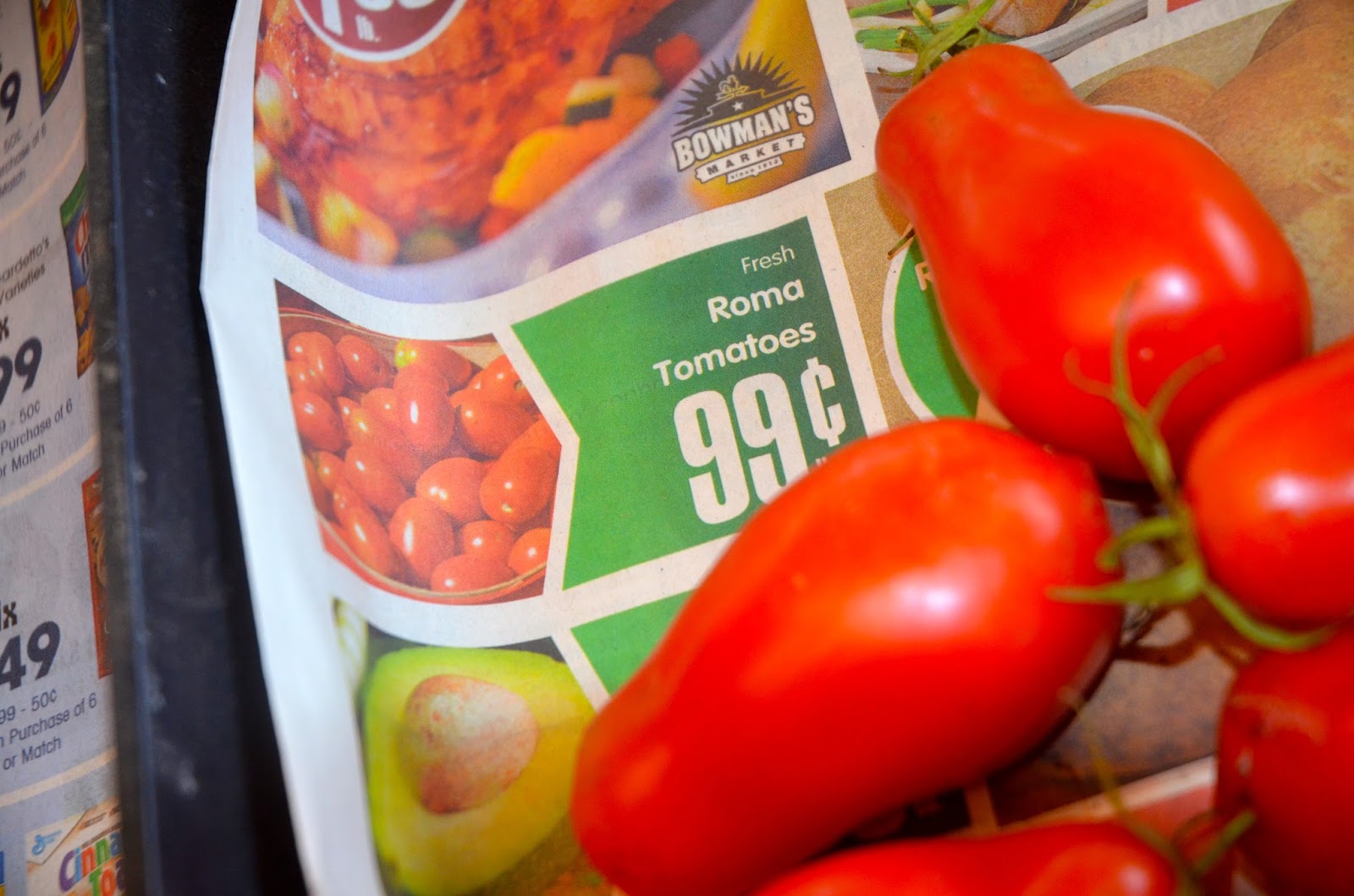
I mentioned that I first put a piece of newspaper in the flats, which is because the plastic bottom is a wide grid instead of a solid piece, and I don't want tomatoes to fall out. The coincidence of this ad made me smile and reminded me why I bother saving the tomatoes in the first place:
They'll be much more expensive in winter! How long have you successfully stored fresh tomatoes?
Thursday, October 22, 2015
Poor-man's vacuum sealer, and freezing tomatoes
The demand of my time to preserve the garden's bounty greatly decreased when I discovered how easy it is to freeze tomatoes. There are two methods: whole without peeling (for real!), or by first blanching to remove skins.
I did the latter method for the tomatoes in these pictures. I dipped the tomatoes in boiling water for 30-60 seconds, then removed to an ice water bath. The peels slip off easily. I cored and cut the tomatoes into slices before packing into zipper freezer bags. I find that slicing helps me fit them into bags more efficiently.
My poor-man's vacuum sealer is a straw. Put the straw against one edge of the bag, taking care not to submerge into liquid. Close the zipper all the way against the straw, pushing against the bag to squeeze out air. Be careful not to splash! If desired, you can do do a final, gentle inhale on the straw to draw out any remaining air. Watch as you go so you don't suck up any liquid.
This works great to pull out air. It is especially efficient with items not packed in juice, such as green beans. You can pull the sides of the bag right next to your food, eliminating the air pockets that invite freezer burn.
I fill quart-size bags with 3-4 cups of tomato slices with their juice. Lay the bags flat on a cookie sheet and transport to the freezer. This helps them freeze flat without molding to the shelf. The tray also corrals any drips as you walk to the freezer (not that I would know about this!). Once frozen you can take bags off the tray. I like to store them upright, like books on a shelf. You could also do smaller amounts in a bag to create a thinner sheet of tomato goodness that you can easily break off when you want to throw some flavor into what you're cooking.
The other method of freezing I mentioned is to freeze tomatoes whole. First remove the core. Then place on a sheet for flash freezing (so they don't stick to other tomatoes). Place in bag once frozen. You can do the straw method to remove extra air from the bag.
When you want to use a frozen tomato, run it under warm water to gently remove the peel.
Freezing tomatoes whole is a huge time saver but does take more freezer space than blanching and slicing.
I still can tomatoes, but I don't always have enough tomatoes at once to do a full batch. And oh, the time canning takes! Freezing tomatoes instead is a fantastic option. Canning tomatoes takes more time and energy up front; freezing is simple but of course requires energy to store them. I've had them store well in the freezer for a year. No matter which preservation method -- freezing or canning -- these tomatoes are ideal for use in soups or sauces.
Wednesday, October 7, 2015
Check tomatoes for damage after heavy rains
Summer showers give gardeners hours
(that would otherwise be spent watering),
but what does too much rainfall bring?
SPLIT TOMATO SKINS
If a big storm is in the forecast, it is worthwhile to harvest ripening tomatoes ahead of time to ensure the plants don't get overwatered and cause the fruits to split. Any tomato with a hint of color can ripen off the vine just fine. A pre-emptive harvest gives you more control over when to use the ripening tomatoes. Removing the fruit also lightens branches and spares them from damage when winds and rain are fierce. Worse than a split-skin tomato is a tomato that a storm pushed to the ground off a broken branch. Guess I'm off to make sauce!
Friday, October 2, 2015
Eat the Seasons: Roasted tomato sauce and soup base
Small tomato varieties -- such as grape, cherry and yellow pear -- get typecast as salad fare. Harvest some greens, throw in these little tomatoes, BAM! Done.
Last year I had way more little tomatoes than salads in my future. I experimented with ways to cook and preserve the bounty.
My favorite was to roast the tomatoes with olive oil, salt and garlic, and then puree the mixture for pasta/pizza sauce or as the start to a delicious tomato soup. These are guidelines rather than specific quantities.
To make, spread tomatoes in a single layer in a pan or on a cookie sheet. Drizzle lightly with olive oil and sprinkle with salt, then stir. You want enough oil to coat the tomatoes, but not so much that the tomatoes swim in the pan. If desired you may also add garlic cloves and herbs, although I like to throw the fresh herbs in at the end of cooking. Don't chop garlic, because the smaller the pieces, the more likely they will burn.
Cook in a 350 degree oven, checking after a half hour. You want the tomatoes to be wrinkled and release their juices, but only barely start to caramelize and show a bit of brown on the skin. Once they reach this point they can burn quickly. Behold, the pan of tomatoes that was almost there, and for which I decided to turn off the heat but leave in the oven when I picked up a child from school:
![]() |
| Oops! In the oven too long. |
All the juice and olive oil cooked away, and the skins were papery. It was a mess! Not good.
In contrast, here's what you want the cooked tomatoes to look like:
| Ah, perfect. |
Roasting tomatoes will fill your home with the most tantalizing aroma. Puree in a blender or food processor to make the sauce. You may choose to run the sauce through a strainer to remove seeds and larger skins. I list this as an option, for if I plan to use the sauce on pizza I don't bother to do the straining step.
For sauce: Adjust seasonings, adding salt and pepper to taste. Some sauces made from larger tomato varieties benefit from the addition of sugar, but I have found that the grape tomatoes especially impart just the right amount of sweetness.
To make soup, add more liquid (water or broth) to desired consistency. Depending on how fine your strainer is, you may find it easier to strain the seeds AFTER adding more liquid instead of pushing the initial puree through a sieve.
When your soup start is nicely blended, season to taste with salt and pepper; place in sauce pan to warm. Add chopped fresh basil and a touch of cream (about a 1/4 cup per quart of tomato mixture) and serve as soon as cream is warmed through. OK, this makes a fine soup all by itself, but the cream sends it over the top on the yummy scale.
The roasted tomato puree freezes well.
Tuesday, July 28, 2015
Pregnant tomatoes!
Monday, July 18, 2011
Tomato Hornworm
It seemed to happen so quickly! The tomato hornworm is difficult to see, it's like playing "Where's Waldo" since they are green and just lay along the stems and sometimes hide under leaves. Their damage is easy to detect, the hungry munchers eat all the leaves and just leave the stems. My running partner wanted to see our garden, and instead of a morning run, we spent a half hour searching for these little buggers, we found over 20! The best and most organic thing to do is to keep watch, pick them off, and smash them. I've told the kids that there is a 50 cent bounty on each hornworm brought to me dead or alive.
Image
Tuesday, May 24, 2011
Sideways glance: One way to plant tomatoes
OK, now lower your elbow and make an L. Is your hand still raised, fingers still pointing up?
My tomato seedlings this year grew extremely leggy. It wasn't really my plan. I started them indoors under lights in their little black plastic pots, then dutifully rotated them to the patio to harden off before advancing to the garden. In a fit of energy I took apart my light rack and put it away. That was before a day of cold, dark, wet yuckiness.
I brought the seedlings back inside, thinking the sun'll come out tomorrow -- no need to set up the grow lights again. No such luck. The cold day lasted more than a week, and the indoor hostages grew gangly stretching to find light.
Actually, I think these tomatoes may be stronger for it. When it finally warmed up and dried out somewhat, I introduced the tomatoes to the garden. For each I dug a hole about 8 inches deep and set the plant in on its side. Think of the root ball as your shoulder in our earlier exercise. Your tomato plant arm is outstretched. Holding the plant mid-stalk, I carefully made an elbow and held the plant upright as I filled the hole with dirt, bringing the soil level to about an inch below the lowest leaf. Most of my tomatoes were longer from shoulder to elbow (the horizontal section) than raised forearm.
Friday, August 13, 2010
Tomato Tip
UPDATE: Maybelline, a faithful backyard farming reader, left a comment saying that you don't need to blanch and peel the tomatoes before freezing (even better, right?) Just run them under warm water and the skins should peel right off.
Wednesday, January 20, 2010
Tomato Quiz Answers
Send your address to backyardfarming{at}gmail{dot}com
1. Tomatoes are native to what continent?
a. Asia
b. South America
c. Europe
d. Australia
2. In what year did the U.S. Supreme Court rule that the tomato is a vegetable and not a fruit?
a. 1800
b. 1999
c. 1893
d. 1776
The case was NIX v. HEDDEN, May 10, 1893. Imported vegetables were subject to a 10% duty; fruits were free. Mr. Hedden was the tax collector, and Mr. Nix, after paying duties on tomatoes under protest, sued him for a refund, reading in evidence the dictionary definitions of "fruit", "vegetable" and "tomato." The court found that for purposes of trade and commerce, "the common language of the people" was to be followed rather than botanical definitions. Tomatoes, like potatoes, carrots, parsnips and other vegetables, are served with the main part of the meal; fruits generally as dessert. The plaintiff got no refund.
(Information found here)
3. You should store your tomatoes
a. in the fridge
b. at room temperature
c. in the attic
d. in the doghouse
4. When the French first were introduced to the tomato, they called it
a. the apple of love
b. apple of paradise
c. nasty
d. perfect for french fries
5. About how many varieties of tomatoes are there?
a. 5
b. 100
c. 1000
d. 10,000
(if you answer A, you need to get out to a farmers market!)
6. Which country produces the most tomatoes?
a. America
b. China
c. Italy
d. Chili
7. The largest documented tomato weighed
a. 3 lbs. 4 oz.
b. 7lbs. 12 oz.
c. 9lbs. 1 oz.
d. 5 lbs. 8 oz.
8. Botanically speaking, a tomato is a fruit
True
False
Monday, January 18, 2010
I Say Tomayto, You Say Tomahto...Quiz
Okay, here are the rules. You have to make your best guess, no cheating and looking up the answers on the internet!
1. Tomatoes are native to what continent?
a. Asia
b. South America
c. Europe
d. Australia
2. In what year did the U.S. Supreme Court rule that the tomato is a vegetable and not a fruit?
a. 1800
b. 1999
c. 1893
d. 1776
3. You should store your tomatoes
a. in the fridge
b. at room temperature
c. in the attic
d. in the doghouse
4. When the French first were introduced to the tomato, they called it
a. the apple of love
b. apple of paradise
c. nasty
d. perfect for french fries
5. About how many varieties of tomatoes are there?
a. 5
b. 100
c. 1000
d. 10,000
(if you answer A, you need to get out to a farmers market!)
6. Which country produces the most tomatoes?
a. America
b. China
c. Italy
d. Chili
7. The largest documented tomato weighed
a. 3 lbs. 4 oz.
b. 7lbs. 12 oz.
c. 9lbs. 1 oz.
d. 5 lbs. 8 oz.
8. Botanically speaking, a tomato is a fruit
True
False
Leave your answers in a comment. Yes, there will be a winner. The first person to comment with all the correct answers will win a packet of my favorite heirloom tomato seeds. Answers will be announced Wednesday January 20th.
Remember~No cheating! Cheaters never win...well, sometimes they do. Just don't cheat.
~marisa
Wednesday, August 26, 2009
A super duty trellis
We are tired of tomato cages that fall over and leave our tomatoes a tangled mess of diseased plants that are impossible to water, weed, and harvest. String weaving is more labor intensive with the same results. So this year we devised a system that will change our whole garden. Using sturdy metal T posts and heavy welded wire fencing, we erected a trellis that keeps the tomatoes off the ground. As we train the vines into the fencing, the tomatoes grow up into the sun and air never to topple over. A furrow at the base makes irrigation easy. Circulating air wards off disease reducing the need for fungicides. We have been rewarded with a heavy crop of beautiful tomatoes that will continue into autumn. This same trellis will serve future crops of peas, pole beans, cucumbers, and vining squash. As we construct more of these trellises, our vertical garden will generate higher yields and better quality produce.
Friday, October 17, 2008
Our Last Great Tomato Harvest
This time of year is always so sad for me. The weather gets colder and I have to watch my garden wither and die. We had one last tomato harvest this last week, I will miss seeing all the beautiful colors and different varieties of tomatoes we planted this year. It was fun to bring our purple tomatoes to friends homes and parties (pictured on the right), people would inform us that our tomatoes have spoiled or gone bad. Then we had the chance to educate them on heirloom tomatoes. They would taste the tomatoes and be so surprised at the amazing flavor. I will be collecting the seeds and sharing them with my friends in hopes that we will increase the diversity of produce being planted, and take some power away from Monsanto.~marisa
Monday, October 13, 2008
So many (green) tomatoes, so little time
So what’s it going to be, Mr. Tomato Head? Are you coming or going?
This sight in my yard, the utter juxtaposition of the garden’s life cycles, amused me. Within hours it’s supposed to snow here. (Psst . . . don’t tell this guy. He’s banking on many more sunny days ahead.)
It’s not a bad philosophy really, to be filled with so much optimism that we never shut down. But I know the cold, hard truth. Emphasis on cold.
Unless you’re fortunate to live in a temperate climate, cold will come, and your tomatoes will not like it. It can break a gardener’s heart to see a plant not reach its potential! Yet don’t despair when forecast frosts come up against plants still full of fruit.
Squeeze more out of your plants by covering them with blankets at night, or by harvesting green tomatoes to ripen indoors. Covering your plants at night is helpful when you know that an early freeze will be followed by warmer temps again, in which tomatoes can still develop. In preparation for a hard frost (the sure sign of winter), an early harvest is the only way to go.
The best candidates for ripening off the vines are those tomatoes that already show a slight blush. Teeny green tomatoes most likely will not turn red; they have to be full-size to ripen. If you’re picking tomatoes to avoid a hard frost and aren’t sure if one is full-grown, go ahead and harvest it anyway; you have nothing to lose.
Store your tomatoes in a single layer in a dark place with a steady temperature (best on the cool side). Garages or unheated basement rooms are ideal. I like to use black plastic planting flats or the shallow cardboard boxes from cases of canned goods to store my tomatoes.

With large quantities, sort tomatoes by degree of ripeness, or shades of the rainbow, into your trays. It makes sense that all tomatoes of similar colors should ripen about the same time.
If you are bursting with green tomatoes, wrap them individually in a sheet of newspaper before placing in your storage tray. Open a few every week to assess level of ripeness. You may also bring some into your warmer kitchen to ripen when you’re ready to use them soon. Although I can’t explain why, I know this method works to preserve your tomatoes well past Christmas! Sure, these tomatoes may pale compare to those at the peak of summer, but it still beats grocery store fare. They are particularly good in cooked dishes.
Another option, if space allows, is to rip up your entire plant and hang it upside down inside, like in your furnace room. Hanging provides good air circulation, and another bonus is that this step may appeal to you as a faster way to harvest.
Rather than waiting for tomatoes to ripen you may also want to try recipes using green tomatoes. I haven’t done this yet, but would love to hear any of your tried and true favorites.
I have had great success with my end-of-season tomato harvests, often times exceeding the amount of tomatoes I gleaned during the summer. What a great way to extend the joy of gardening.
Jennifer